| Category | Territorial scope | Level of regulation |
|---|---|---|
| PGI | Wide area | Flexible |
| Quality Wine | Defined area | Medium-High |
| DO / PDO | Wine region | High |
| DOCa | Historical excellence | Very high |
| Vino de Pago | Individual estate | Very high |

When a label mentions Ribera del Duero, Rioja or Rueda, it is not only indicating a place of origin. It is telling a story.
It speaks of a specific landscape, of varieties adapted over generations and of a set of rules created to preserve a common identity. In wine, origin is not a secondary detail: it is an essential part of the final result.
Wine designations arise precisely to protect that relationship between territory and product. However, terms such as DO, DOP, DOCa, IGP or Vino de Pago often generate confusion even among regular consumers; therefore, understanding what each category means allows a bottle to be interpreted beyond the brand or the price. It allows understanding what lies behind the wine even before opening it.
A Denomination of Origin (DO) is a certification system that regulates how a wine must be produced within a specific geographical area.
It is not merely about defining a territory on a map. A DO establishes the conditions under which that wine can exist and be marketed under the name of that region.
Each designation defines a set of common rules that affect key aspects of the process:
These rules do not aim for all wines to taste the same. Their function is to protect a collective style built over time and to prevent the prestige of a region from being diluted.
In other words, the DO acts as a shared commitment between producers and consumers: it guarantees authenticity and consistency with the territory.
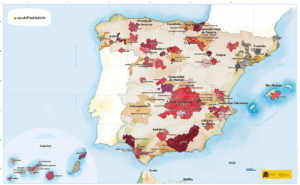
With the creation of a common European regulation, the term Protected Designation of Origin (PDO) appeared.
From a practical point of view, both figures represent exactly the same concept.
Many regions use both terms simultaneously because they pursue the same objective: ensuring that the wine truly comes from the place indicated on the label and that it has been produced under verifiable standards.
It is important to clarify a frequent misunderstanding: PDO does not mean higher quality than DO. It simply belongs to a different legal framework.
Within the Spanish system there is a higher level reserved for designations with a particularly consolidated track record: the Qualified Denomination of Origin (DOCa).
This category recognizes designations that have consistently demonstrated high levels of quality and control over time.
Currently, only two Spanish regions hold this distinction: Rioja and Priorat.
To reach this level, requirements are applied that reinforce the usual functioning of a DO, such as stricter controls in production and commercialization, particularly rigorous traceability from vineyard to market, and mandatory bottling within the area of origin.
Many of these practices also exist in Denominations of Origin, but in a DOCa they are applied with a higher and sustained level of demand and supervision over time.
DOCa thus recognizes something fundamental in the world of wine: not only producing great wines, but doing so consistently year after year.
The concept of Vino de Pago introduces a different logic within the Spanish system.
While traditional designations protect entire regions, here recognition is granted to a specific estate whose natural conditions produce wines clearly differentiated from their surroundings.
They represent the highest expression of the terroir concept at the smallest scale: a unique place capable of expressing its own identity without depending on a broader regional designation.
If you are interested in learning more about Vinos de Pago, you can consult our specialized blog on the subject here.
The Protected Geographical Indication (PGI) —historically known as Vino de la Tierra— maintains the link with a geographical area, although with less restrictive regulations.
This framework offers greater flexibility in aspects such as:
Choice of varieties, including non-traditional grapes.
Production techniques.
Styles and winemaking approaches.
Far from implying lower quality, PGI often becomes a space for innovation. Many producers use it to experiment, recover minority varieties or explore styles that would fall outside the more rigid rules of a DO.
In many cases, it is the creative laboratory of Spanish wine.
Within the Spanish classification there is an intermediate category known as Quality Wine with Geographical Indication (VCIG), commonly simplified as Quality Wine.
This designation acts as a transitional stage between PGI and Denomination of Origin. In many cases, this category functions as a consolidation period. After several years demonstrating consistency and quality, a region may apply for recognition as a Denomination of Origin.
For this reason, it can be understood as the step that connects the flexibility of PGI with the more consolidated structure of a DO.
| Category | Territorial scope | Level of regulation |
|---|---|---|
| PGI | Wide area | Flexible |
| Quality Wine | Defined area | Medium-High |
| DO / PDO | Wine region | High |
| DOCa | Historical excellence | Very high |
| Vino de Pago | Individual estate | Very high |
Designations provide three fundamental guarantees:
However, it is important to understand something essential: the designation does not make the wine by itself.
Two bottles from the same area can be radically different. The climate of each vintage, vineyard work and the winemaker’s decisions remain decisive.
The designation establishes the framework.
The producer interprets that framework.
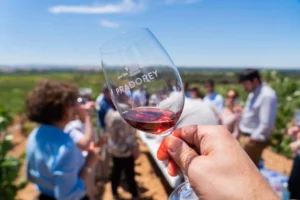
Wine continues to be one of the few agricultural products where place matters as much as technique.
Soil, climate, altitude, orientation, tradition and accumulated knowledge form an inseparable part of the final result. Each bottle is, to a certain extent, a liquid translation of a landscape.
That is why, when a label mentions a specific designation, it does not only provide information about origin. It speaks of identity.
And understanding that identity is, probably, the first step to understanding wine.
¿Te ha gustado este artículo?